Zweigelt is the most common red grape grown in Austria, where it was first created. It is named after Fritz (Friedrich) Zweigelt who did the original cross of St Laurent and Blaufrankisch in 1922. The grape was first known as Rotburger but the name got changed in the 1970s in honor of its creator. Friedrich Zweigelt had a double doctorate in entomology (study of insects) and phytology (study of algae). He was also Head of State Vine Cultivation. He was a highly regarded figure of Austrian viticulture. He also had strong views as a German Nationalist. He became an official of the Third Reich. Following WWII, he was held in a detention camp until his trial. His trial was stopped because he was found to be a minor offender and was pardoned. In the last decade, there has been a small movement to ‘free a fine wine from its unfortunate namesake’. In 2019, there was a vote by a committee of historians to rename the grape but the committee did not recommend a renaming. Producers are allowed by law to label their wines as either Zweigelt or Rotburger. Austria has had its share of bad wine publicity in addition to this black mark. In 1985, it was discovered some winemakers were adding antifreeze (diethylene glycol) to wines to increase their sweetness and body. There were no confirmed deaths from these wines but some were found to have much higher levels than considered safe for human consumption.
Zweigelt is a high yielding vine so care must be taken in the vineyard to control the vine’s vigor to produce higher quality wines. If yields are controlled, the resulting wines are full bodied and have the capability to age. Zweigelt is used for the production of varietal wines, as well as in blends. In blended wines, it contributes red fruit character.
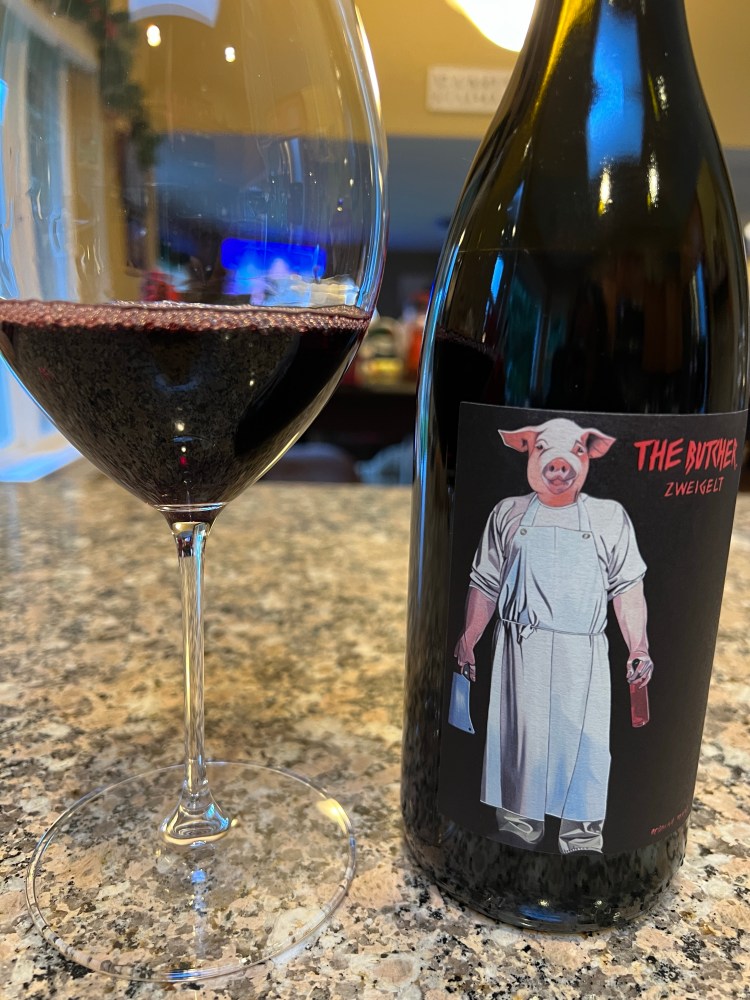
This week, I drank a 2020 Joann Schwarz ‘The Butcher’ Zweigelt from Burgenland, Austria. Hans Schwarz was originally a butcher prior to becoming a grape grower. In 1999, the Schwarz family produced their first wine. Prior to this, they sold their harvest to a local co-op and to local winemakers. In 2017 Hans’ son, Michael, took over the winery. The wines the family produces are vegan, meaning that the agents used to fine their wines are not derived from animals (most commonly egg whites). Fining removes unwanted particles from the wine before bottling. This wine is a deep ruby color. Savory aromas of meat, bramble, wet stone, and herbs were evident on the nose. It also has scents of vanilla, black cherry, red cherry, wild blackberry, and black currant. On the palate, this dry wine has a bright acidity. There is a high amount of smooth, ripe tannins that add substantial texture. This wine has a low end of moderate amount of alcohol. The aforementioned aromas also present themselves when tasting this wine and linger on the long finish. This is a great, inexpensive bottle to pair with all types of meat. According to the website for the importer, this wine can be served with ‘anything your local butcher sells’.
-TheLooseTannin
 A Trip Around the World of Wine in 52 Weeks